

Beyond Speculation: 5 Paradigm-Shifting Insights from Grounded Truth Theory
By
Professor Dele A. Ilesanmi
(Professor of Biblical Research, Theology, and Biblical Education)
In the volatile landscape of modern thought, the boundary between human conjecture and divine certainty has become dangerously porous. For the serious researcher, the challenge is no longer just finding information, but establishing a framework that is both academically rigorous and spiritually faithful.
Professor Dele A. Ilesanmi’s “Grounded Truth Theory” (GTT) offers a clear solution to this problem by providing a method based on Scripture, helping researchers identify and confirm truth through the authority of the Bible.
- Truth is Revealed, Not Invented
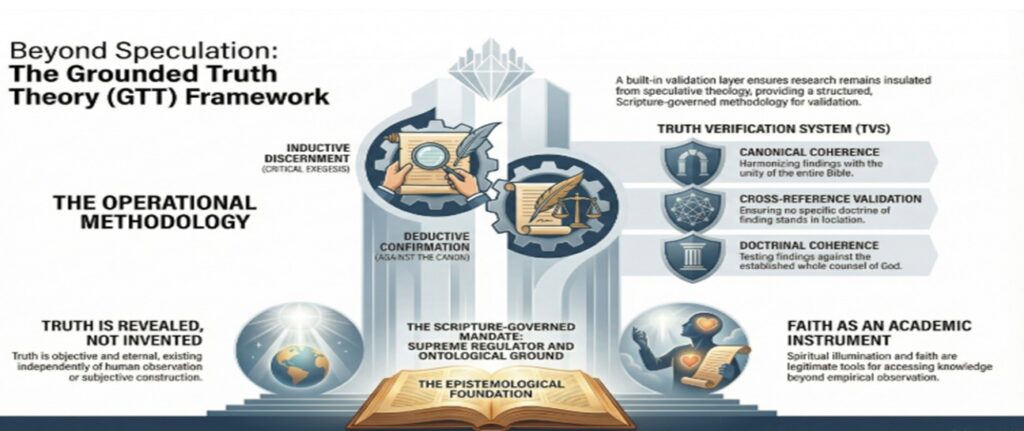
GTT is rooted in a robust ontological foundation that shifts the researcher’s identity from a creator of meaning to a seeker of established reality. In biblical theology and biblical education, truth is not discovered or constructed but revealed. Unlike secular models that view data as something to be “constructed” or interpreted through subjective experience, GTT asserts that truth has a pre-existing, divine source.

By establishing Scripture as the “ontological ground” (John 17:17), GTT demands a posture of intellectual humility. The researcher acknowledges that truth is objective, absolute, and eternal, existing independently of human observation. The Word is not merely a resource; it is the supreme authority and regulator of truth.
“Truth is not invented or constructed from data but grounded in divine revelation preserved in Scripture.”
- The “Dual Engine” of Induction and Deduction
GTT operates via a “Dual Engine” methodology—a sophisticated movement between inductive discernment and deductive confirmation. The theory utilises academic processes such as critical exegesis and theological coding to derive truth upward from the text, then employs deductive truth testing to ensure these findings align with the total authority of the canon.

This approach finds its biblical precedent in the Bereans (Acts 17:11), who utilised Scripture as a methodological validation instrument to “search the scriptures daily” to see if things were so. By combining these logical movements, GTT ensures that theological synthesis remains anchored to the text while being validated by the whole counsel of God. Hence, the Bible says, “Prove all things; hold fast that which is good” (1 Thess 5:21).
- Faith and Spirit as Academic Instruments
The “Epistemological Foundation Layer” of GTT challenges the secular academic bias that excludes the supernatural from “serious” inquiry. It posits that certain tiers of knowledge are inaccessible through empirical observation alone, requiring specific spiritual instruments for “discovery.” In this framework, the researcher’s spiritual state is considered as relevant as their analytical skill.
GTT legitimises Faith (Heb 11:3) and the illumination of the Holy Spirit (1 Cor 2:10) as essential academic tools. This framework recognises that the Spirit “searcheth all things, yea, the deep things of God,” effectively bridging the gap between rigorous critical analysis and divine revelation.
- A Built-In “Truth Verification System” (TVS)
To insulate research from “speculative theology,” GTT incorporates a “Validation Layer” functioning as a Truth Verification System (TVS). This layer is anchored in the principle of Canonical Coherence—the requirement that any specific finding must harmonise with the unity of the entire Bible. As Isaiah 34:16 commands, researchers must “seek ye out of the book of the Lord,” ensuring no doctrine stands in isolation.
This TVS utilises specific mechanisms to maintain doctrinal integrity:
- Canonical coherence validation
- Cross-reference validation
- Doctrinal coherence testing
- A Theory Built for Action, Not Just the Library
GTT is a meta-theoretical powerhouse built for action. It transcends the library to judge contemporary thought. It evaluates philosophy biblically. It critiques scientific claims through revelation. It directs ministry ethics. It builds structured theological knowledge for real-world application. GTT functions as the final regulator of all truth.
Conclusion: The Future of Biblical Inquiry
Grounded Truth Theory restores Scripture as the supreme authority and regulator of truth. By merging academic rigor with spiritual illumination, it offers a definitive path out of the fog of speculation and into the clarity of divine revelation. As we navigate an era of increasing ambiguity, we must ask: how would your search for truth change if you adopted a Scripture-governed framework?
For a better understanding, consult: Ilesanmi, Dele Alaba. “Grounded Truth Theory as a Scripture-Governed Research Framework for Biblical-Theological Inquiry: Discerning Divine Truth Inductively and Deductively”. International Journal of Biblical Research Studies 2, no. 2 (February 28, 2026): 1–46. https://doi.org/10.5281/zenodo.18817956.
Top of Form